What's new in science?
Cool recent discoveries, explained for GCSE students.
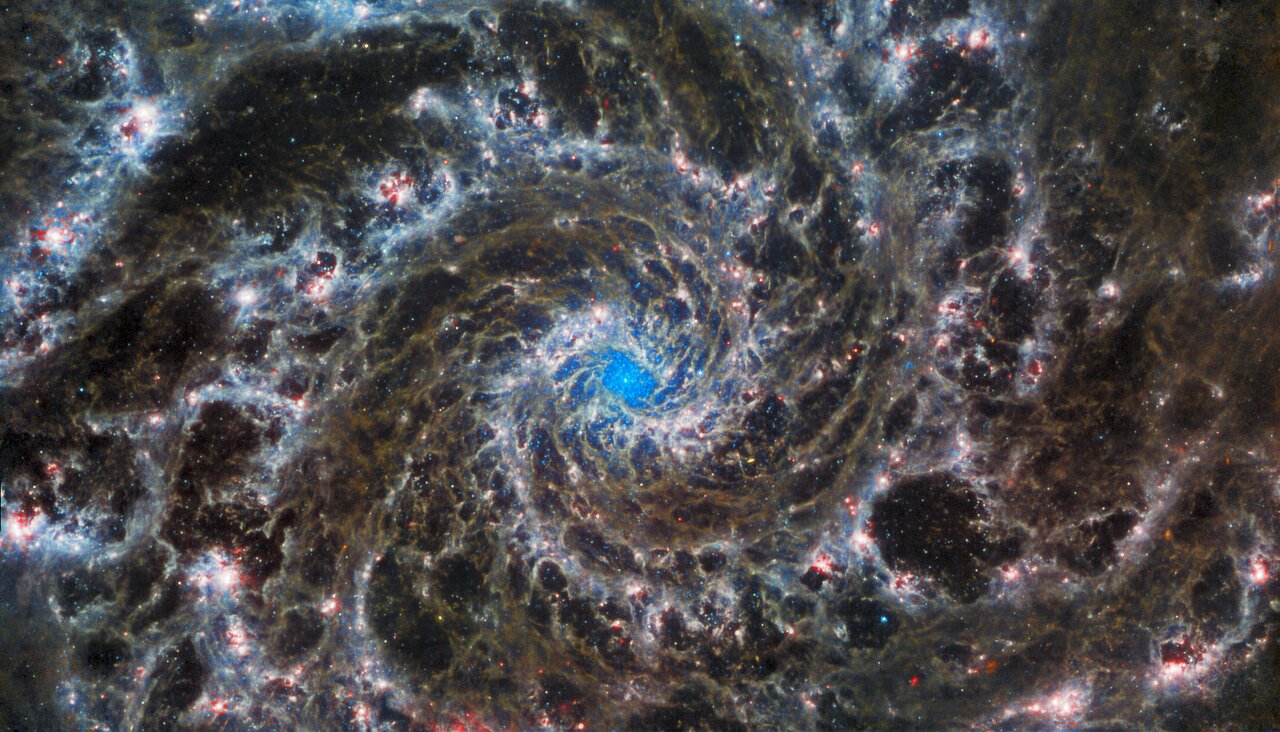
The James Webb Space Telescope is rewriting everything we thought we knew about the early universe
The James Webb Space Telescope (JWST) is the most powerful telescope ever built — and it's floating 1.5 million km from Earth. Since launching in 2021, it's been peering further back in time than anything before it, finding galaxies that formed just a few hundred million years after the Big Bang. Some of these galaxies are way bigger and brighter than anyone expected, and scientists are still trying to figure out why.
The JWST was originally supposed to cost about $500 million and launch in 2007. It ended up costing nearly $10 billion and didn't launch until Christmas Day 2021. That sounds like a disaster, but the reason it took so long is because the engineering is genuinely insane. The telescope has a 6.5-metre mirror made of 18 hexagonal segments, and each one is coated in a thin layer of gold. Why gold? Because gold is brilliant at reflecting infrared light, which is exactly what JWST is designed to detect. Light from the very first stars and galaxies has been stretched by the expansion of the universe (this is called redshift — you'll meet this in GCSE physics), so by the time it reaches us, visible light has shifted into the infrared. You need an infrared telescope to see it. To detect faint infrared signals, the telescope has to be incredibly cold — its instruments operate at around minus 233 degrees Celsius. It has a sunshield the size of a tennis court that keeps the Sun's heat away from the mirrors. So what has it actually found? Quite a lot: - Galaxies that shouldn't exist. JWST has found massive, well-formed galaxies from just 300-400 million years after the Big Bang. Our models said the universe wasn't old enough to build galaxies that big, that fast. Something about our understanding of early galaxy formation is wrong, and physicists are working on figuring out what. - The most distant objects ever seen. JWST has confirmed galaxies at redshifts above 13, meaning the light left them over 13.4 billion years ago — when the universe was barely 2% of its current age. - Stunning images of nebulae and exoplanet atmospheres. It detected carbon dioxide and water vapour in the atmosphere of a planet orbiting another star. That's a big deal for the search for habitable worlds. - The chemistry of the first stars. By splitting the light from distant galaxies into spectra (like passing it through a prism), scientists can work out what elements were present. The first stars were made almost entirely of hydrogen and helium — heavier elements like carbon, oxygen, and iron were forged later in supernovae. The reason JWST matters for your GCSE is that it's a real-world example of the electromagnetic spectrum in action. Everything it does comes down to detecting infrared radiation, understanding redshift, and using spectra to identify elements — all things you'll study in physics and chemistry. The difference is that JWST does it across 13 billion light-years.